Home | Graves Grace Church, Dorchester, MD | Graves Grace1 | Graves Bethlehem Church, Dorchester, MD | Graves Bethlehem1 | Graves Bethlehem2 | Our Dorchester | Planting at Old Trinity | First to Arrive | 1665 The First Play | Fosque | Bacon's Rebellion | Friends of Maryland and Virginia | Sarah Brooks Woolford | Mary Levin MacNamara | On the Bay | Western Shore | Brewers | O P Johnson, CSA | Alexandria | McGuires and Medicine | Wimsatts | Rest in Washington | Dunnock / Woolford | Johnson / MacNamara | Liverpool | D A C | Dames & Daughters | Contact Us
Brewers - Henry and his Family

Dunnock Johnson Family


The War of 1812

Our ancestor, Zachariah Brewer died in Canada in May, 1813 while serving the first year of his five year enlistment. He was a corporal in the 14th Infantry.

The following is taken from a history of the US Army Medical Corps and discusses medical care for soldiers in the Northern campaign (New York and Canada).

   -----------------------------------------------------------------------------

During the first campaign season of the War of 1812, the physicians caring for the regular soldiers of the U.S. Army were forced to work under a decentralized, peacetime organization. During the second season, the effort required to meet the unpredictable demands of war at the same time that the Medical Department was being reestablished made it difficult for Army surgeons to give their patients the best care available even by nineteenth century standards.

SEASON OF 1812

For the attack against Canada from the American side of the St. Lawrence River, six thousand to eight thousand men were gathered in the fall of 1812 at Greenbush, near Albany, under the personal command of Maj. Gen. Henry Dearborn. In November, the army marched from Plattsburg, New York, to launch an attack against Montreal. The militia, however, stood on its right not to fight on foreign soil. Those who did cross into Canada managed to fire on one another in the confusion. After the fiasco, the militia returned home and the light artillery and dragoons returned to Greenbush. Three regiments of regulars went to Burlington, Vermont, for the winter, while three more spent the season at Plattsburg.

Maintaining the health of the troops in this area was a problem from the outset. The season was rainy and the ground was wet. Although the camp at Greenbush was often moved, diarrhea and dysentery took a considerable toll. Not only intermittent fever but also typhus and rheumatism were prevalent even as early as mid-September. Despite the threat to the army posed by the high disease rate, when Dr. James Mann, placed in overall charge of the medical services for the forces in upstate New York, arrived at Greenbush the second week in August, he found that the physician who was to have preceded him had not arrived and that the troops were without medical care.

Since no preparations had been made to care for those of the men at Greenbush who might fall ill, upon his arrival Mann had to go over the hospital supplies, which, fortunately, he found to be in good order, as well as to care for the ill with the aid of but one other physician, a regimental surgeon's mate who arrived a few days after Mann. There were no buildings prepared to receive the sick and Mann did not wish to erect new tents because of the wet ground, so the sick were left in the tents they shared with their healthy comrades. An average of 100 men fell ill each week at Greenbush, and by the time the last units of the army left for the abortive attack on Montreal, a total of 200 men had been left behind because of poor health. Nevertheless, Mann believed that the health of the men at Greenbush was good when considered in the light of the fact that most of them were new to the military life.

Mann decided that the convalescents in his care did not need the full diet required by the healthy and active soldier. Mann suggested that the convalescent receive 12 ounces of meat and 12 ounces of bread a day. The "half diet" should consist of 6 ounces of meat and 10 ounces of bread, with the addition of a gill of rice or a half pint of meal plus half a gill of molasses. Those on a "low diet" should receive only bread, rice, or barley with sugar, without any meat. Although chocolate or tea with sugar was to be permitted from time to time, Mann opposed the use of whiskey.

Mann regretted being so busy with his responsibilities as hospital surgeon that he had little time to study the diseases he encountered and to record his observations. During the fall and winter of 1812-13, however, he saw many cases of rheumatism, pneumonia, measles, dysentery, and intermittent fever. When he first arrived at Greenbush, he also found that a few of the men had fallen ill with what he diagnosed as typhus before they reached the camp. Four of the seven men who died in the period from mid-August to the end of September were from among this group of typhus patients, and two others who died had long been afflicted with what we would today call tuberculosis.

On the basis of his observations during the first fall and winter of the War of 1812, Mann concluded that rheumatism afflicted men older than 40 more frequently than younger soldiers and was quick to recur after exposure to wet, cold weather in those who had previously suffered from it. Mann preferred to reserve blood-letting for the treatment of the acute form of rheumatism, using calomel, opium, blistering, and the application of warmth for chronic cases.

Among the other conditions studied by Mann were pneumonia and dysentery. In some cases of pneumonia, death could occur within 24 hours of the appearance of the first symptom, which was usually a sensation of weight upon the chest. The convalescent from this form of pneumonia, Mann noted, often had a jaundiced appearance. The type of dysentery seen by physicians in the North at this time "was attended in most cases with a fever of the syochal type, accelerated action of the arteries, and heat increased considerably above the healthy standard." Mann favored treating it by bleeding, preferably a single bleeding of 16 ounces followed by a "full cathartic of calomel and jalap." "Anodynes," or painkillers, might be administered after the "intestines were well evacuated." Mann also discovered that "There were cases when calomel and opium, in small doses, at intervals of 4 or 6 hours, were found beneficial." Emetics were generally used only when all else had failed, but dysentery could take on "a typhoid form" which made the administration of wine or diluted brandy, up to two pints of the former, as well as purgatives, advisable. Milk was also recommended, especially for the convalescent from this variety of dysentery, but meat and broths were strictly forbidden. Intermittent fevers apparently appeared at Greenbush only in men hailing from south of the Hudson River who had had the disease before. These men were treated with emetics when the "cold stage" was about to appear and then, during periods when there was no fever, with cathartics, bark, and wine in addition to the emetics. A disease which was more common than intermittent fever was measles, which, at one time or another during the winter, afflicted as many as one-third of the entire army.

In May 1813, the enemy attempted to take Fort Meigs before the reinforcement expected by the troops there could arrive. Although the siege was abandoned after nine days, the defenders suffered 81 killed and 189 wounded at a time when the medical support available for them was "extremely deficient in almost every respect." There was "no head to the Hospital Department," and the surgeons were young and inexperienced and, for the most part, from the militia. One officer noted that the militia was content to look for its physicians "wherever a person could be found with a lancet in his pocket, or who had by some means or other obtained the title of doctor." Although there had been a "man of skills and talents" in charge of the medical services at this fort before the siege began, this otherwise unidentified gentleman was no longer in the Army by May of 1813, having left both the fort and the Army, it would seem, in disgrace, considered to be "alike destitute of honor and reputation."

There was no place to put the wounded at Fort Meigs while it was under siege; they lay in trenches "on rails barely sufficient to keep them up out of the water, which in many places from the bleeding of the wounded, had the appearance of puddles of blood." There were even times when there was nothing available with which to cover these unhappy creatures, since the same supply shortages experienced by other camps also afflicted Fort Meigs. The force there was so shorthanded that men could not even be spared to give adequate care to the wounded, several of whom died "of a lock-jaw," brought on, General Harrison believed, by "their great and unavoidable exposure to the cold."

From:  Mary C. Gillett. The Army Medical Department 1775-1818. Army Historical Series. 1981, U.S. Government Printing Office Washington, D.C. 20402 http://history.amedd.army.mil/booksdocs/rev/gillett1/

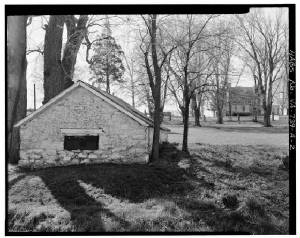
Maplewood in Fairfax, Virginia
maplewood2.jpg
springhouse, c. 1940 (HABS/LC)
The family of John and Lucinda Brewer lived very near the future site of Maplewood at the time of the 1840 census. This has been determined from comparing several decades of Census records with Fairfax County deeds. Maplewood is gone - torn-down in the 1960s. It fronted what is now Route 123 just North of the Beltway.
 

Originally, the land now in Arlington and Falls Church was all Fairfax County. In 1791, a partition was made to establish the 100 square mile Federal City. The Virginia portion was returned. The retrocession was accomplished 1847. Instead of returning the area to Fairfax County, Virginia, Alexandria County remained a separate county. At the time of retrocession, the population of Alexandria County was 10,000, of whom 8,700 lived in the town of Alexandria and 1,300 in the rural area.

Prior to 1870, the city of Alexandria was part of Alexandria County. The "country part" of the County beyond the city's boundaries (essentially consisting of the area that is now Arlington) was a rural community inhabited primarily by people dependent on farming for their livelihood. A number of landowners were residents of the District of Columbia or the city of Alexandria and visited their "country" landholdings from time-to-time. Other than farming, there were only 2 occupations which might be called industry. A brickyard was located near the southern end of the Long Bridge (site of the present-day 14th Street Bridge) and milling operations were located primarily along Four Mile Run, including the Arlington Mill near the crossing of Columbia Turnpike.

In the 1850s, Rebecca Brewers address for her pension claim was the area of the brickyard. Until the 1960s, the brickyard and it successors was in operation along Route 1 next to the Potomac Yards. In 1850, John and his wife Lucinda purchased 30 acres along Four Mile Run and the Colombia Turnpike in Alexandria County. That area today is known as Barcroft and the county is Arlington.

In the 1850 Census, a near neighbor of the growing family John and Lucinda is the miller of Arlington Mill. Barcroft was originally surveyed by George Washington in the mid-18th century as Washington's Forest. George Washington Parke Custis, who eventually inherited the land, established the Arlington Mill on Four Mile Run near Columbia Pike in the early 19th century*. A deed from 1808 describes a nearby property as being by the new saw mill belonging to Custis. later accounts indicate that it was a gristmill, grinding wheat and corn for use on his estate.

Union troops destroyed Arlington Mill after the Second Battle of Bull Run. Renamed the Custis Mill Tract of Washington's Forest, the land was purchased in 1880 by Dr. John Wolverton Barcroft. Barcroft, for whom the community was later named, had moved to Virginia in 1849 from New Jersey, settling on Columbia Pike beyond the county line at Holmes Run. Dr. Barcroft, a physician and inventor, built and operated a mill that had been constructed on the foundation of Custis mill. The new mill, named Barcroft Mill, was said to have the largest wheel on the east coast, establishing it as one of the largest mills on the eastern seaboard. Barcroft also owned a mill further west on Columbia Pike beyond Baileys Crossroads, for which Lake Barcroft is named.

The Brewer farm land is sold in 1853 and the Brewers move on across the Potomac to Washington, DC. Here John calls himself a huckster and he has a stall at the Northern Market. One son, Albert will work as a carpenter for the city police department and another is a Police Officer. Son Kinsey, is later a streetcar conductor.

*Arlington County, Virginia: A History, (Arlington County, VA: Arlington Historical Society, 1976), p. 68 and p. 88.

flagusa.gif

Descendants of Zachariah & Rebecca Brewer

Generation No. 1

1.  ZACHARIAH BREWER was born Abt. 1790 in MD, and died May 1813 in Canada.  He married REBECCA March 31, 1807.  She was born December 1789 in MD, and died May 15, 1876 in Washington DC. He was a corporal in the 14th Infantry in the War of 1812 and he died in the line of duty. Rebecca received a war widow's pension for herself and his orphaned children John and Elizabeth. Rebecca petitions the court in Fairfax and is made her children's legal guardian in 1815.  

Children of ZACHARIAH BREWER and REBECCA are:

2.    i.    JOHN W. BREWER, b. December 01, 1813, MD; d. Aft. June 23, 1900.

      ii.   ELIZABETH BREWER, b. September 25, 1810, Virginia.

Generation No. 2

2.  JOHN W. BREWER (ZACHARIAH1) was born December 01, 1813 in MD, and died Aft. June 23, 1900.  He married LUCINDA DYER Bef. 1835.  She was born 1818 in Virginia, and died February 17, 1883 in Washington DC.

Children of JOHN BREWER and LUCINDA DYER are:

      i.    ALBERT BREWER, b. January 19, 1836, Fairfax, Virginia; d. April 25, 1867, Washington DC.

      ii.   KINSEY BREWER, b. May 18, 1840, Fairfax, Virginia; d. July 08, 1895, Washington DC; m. SARAH.

      iii.  JANE BREWER, b. 1844, Virginia.

3.    iv.   MARTHA ALICE BREWER, b. 1844, Fairfax, Virginia; d. June 01, 1903, Reno, Nevada.

4.    v.    HENRY FENTON BREWER, b. July 24, 1853, Alexandria County, Virginia; d. May 23, 1922, Bethesda, MD.

5.    vi.   ANN REBECCA BREWER, b. January 05, 1857, Washington DC; d. September 25, 1945, Bethesda, MD.

      vii.  ZACHARIAH BREWER, b. 1850, VA.

Generation No. 3

3.  MARTHA ALICE BREWER (JOHN W., ZACHARIAH) was born 1844 in Fairfax, Virginia, and died June 01, 1903 in Reno, Nevada.  She married THOMAS VAN CAMP JULIEN November 09, 1875.  He was born November 18, 1838 in Ohio, and died July 06, 1902 in Reno, Nevada.

Children of MARTHA BREWER and THOMAS JULIEN are:

      i.    ANNIE LOUISE JULIEN, b. August 18, 1876.

      ii.   EFFIE ESTELLE JULIEN, b. October 12, 1877.

      iii.  FRED BREWER JULIEN, b. October 02, 1879.

      iv.   FRANK JULIEN, b. February 27, 1881.

      v.    RALPH JULIEN, b. February 01, 1883.

      vi.   THOMAS JULIEN, b. April 14, 1885.

      vii.  ANITA MAY JULIEN, b. May 06, 1887.

4.  HENRY FENTON BREWER (JOHN W., ZACHARIAH) was born July 24, 1853 in Alexandria County, Virginia, and died May 23, 1922 in Bethesda, MD.  He married MARY ANASTASIA MATTHEW July 23, 1876 in Washington DC at St Mathews Cathedral, daughter of JOSEPH MATTHEW and FANNY A.  She was born December 25, 1860 in Philadelphia, Pennsylvania, and died June 05, 1898 in Washington DC.

Children of HENRY BREWER and MARY MATTHEW are:

      i.    MABEL BREWER, b. 1877, Washington DC; d. July 18, 1897, Washington DC.

      ii.   LUCINDA BREWER, b. 1879, Washington DC; d. October 20, 1895, Washington DC.

      iii.  KINSEY BREWER, b. August 1882, Washington DC; d. April 12, 1911, Washington DC.

6.    iv.   HENRY FENTON BREWER, JR., b. March 08, 1884, Washington DC; d. November 08, 1951, Long Beach, California.

      v.    SALOME BREWER, b. June 25, 1885, Washington DC; d. September 14, 1972, Bethesda, MD.

      vi.   ZACHARIAH BREWER, b. May 1886, Washington DC; d. Bef. 1940.

      vii.  ALICE J. BREWER, b. May 04, 1888, Washington DC; d. March 1973, Largo, Florida; m. GEORGE CRUISE. GEORGE CRUISE and ALICE BREWER: Marriage: Aft. 1954

7.    viii. GUY CONRAD BREWER, b. February 1892, Washington DC; d. January 21, 1939, Washington DC.

8.    ix.   MARK DYER BREWER, b. October 04, 1893, Washington DC; d. July 04, 1989, Largo, Florida.

      x.    DANIEL N. BREWER, b. December 1896, Washington DC; d. Aft. 1930; m. UNK, Abt. 1916.

5.  ANN REBECCA BREWER (JOHN W., ZACHARIAH) was born January 05, 1857 in Washington DC, and died September 25, 1945 in Bethesda, MD.  She married BENJAMIN PERRY, son of CYRUS PERRY and SARAH SUMMERS.  He was born October 1853 in Montgomery, MD, and died 1931.

Children of ANN BREWER and BENJAMIN PERRY are:

      i.    CYRUS ELI PERRY, b. September 26, 1890, Bethesda, MD; d. April 04, 1953, Washington DC; m. ANNE M. STADLER, February 19, 1925, Eldbrooke Church, Wash DC; b. June 20, 1896; d. May 15, 1956, Washington DC.

9.    ii.   JACOB WILBERT PERRY, b. October 17, 1891, Montgomery, MD.

10.   iii.  JOHN BREWER PERRY, b. January 15, 1893, Montgomery, MD; d. May 15, 1961.

      iv.   ETHEL PERRY, b. April 16, 1894, Montgomery, MD; d. September 09, 1960.

      v.    BENJAMIN PERRY, b. July 1896, Montgomery, MD; d. Abt. 1917, France.

Generation No. 4

6.  HENRY FENTON BREWER, JR. (HENRY FENTON, JOHN W., ZACHARIAH) was born March 08, 1884 in Washington DC, and died November 08, 1951 in Long Beach, California.  He married (1) EDNA MARION JOHNSON April 19, 1906 at 319 11 St SW, Washington DC, daughter of CORNELIUS JOHNSON and ELIZA JANE DUNNOCK.  She was born September 06, 1884 in Washington DC, and died December 26, 1966 in Washington DC.  He married (2) ANNETTE RICHTER April 1921 in Colorado.  She was born December 17, 1895 in Baltimore, MD, and died October 30, 1978 in Long Beach, California.

More About HENRY BREWER and EDNA JOHNSON: divorce: May 27, 1921, El Paso, Texas (re-marriage appears to predate divorce).      

Child of HENRY BREWER and EDNA JOHNSON is:

11.   i.    JANE DUNNOCK HENRIETTA5 BREWER, b. January 13, 1909, Washington DC; d. June 01, 1987, Arlington, Virginia.

Child of HENRY BREWER and ANNETTE RICHTER is:

12.   ii.   MARY BARBARA BREWER, b. January 10, 1922, Denver, Colorado; d. May 26, 1987, California.

7.  GUY CONRAD BREWER (HENRY FENTON, JOHN W., ZACHARIAH) was born February 1892 in Washington DC, and died January 21, 1939 in Washington DC.  He married HELEN ZENNETTE.

Children of GUY BREWER and HELEN ZENNETTE are:

      i.    WILLIAM S.5 BREWER, b. Abt. 1920.

      ii.   GUY C. BREWER, JR, b. 1917.

      iii.  ROBERT S. BREWER, b. Abt. 1920, MD.

8.  MARK DYER BREWER (HENRY FENTON, JOHN W., ZACHARIAH) was born October 04, 1893 in Washington DC, and died July 04, 1989 in Largo, Florida.  He married HELEN A., Long Island, NY. 

Children of MARK BREWER and HELEN A. are:

13.   i.    JUNE BREWER, b. Abt. 1920, Long Island, NY.

14.   ii.   MARY BREWER, b. Abt. 1930, Long Island, NY.

9.  JACOB WILBERT PERRY (ANN REBECCA BREWER, JOHN W., ZACHARIAH) was born October 17, 1891 in Montgomery, MD.  He married (1) EVA.  She was born in Washington DC.  He married (2) ELIZABETH RILEY. 

Child of JACOB PERRY and EVA is:

      i.    WILBERT R. PERRY, b. 1915; d. July 1980, Cedar Hill Cemetery, Prince Georges, MD; m. BEATRICE.

10.  JOHN BREWER4 PERRY (ANN REBECCA3 BREWER, JOHN W.2, ZACHARIAH1) was born January 15, 1893 in Montgomery, MD, and died May 15, 1961.  He married MARY ETHEL BURROWS.  She was born March 28, 1895, and died May 21, 1976.

Children of JOHN PERRY and MARY BURROWS are:

      i.    JOHN BREWER PERRY, JR, b. January 08, 1919, Washington DC; d. August 22, 1980.

      ii.   VIRGINIA ETHEL PERRY, b. March 25, 1922, Washington DC; d. November 26, 1996.

      iii.  BENJAMIN PERRY, b. September 29, 1924, Washington DC; d. June 27, 1999, Montgomery, MD.

      iv.   [living]

Generation No. 5

11.  JANE DUNNOCK HENRIETTA BREWER (HENRY FENTON, HENRY FENTON, JOHN W., ZACHARIAH) was born January 13, 1909 in Washington DC, and died June 01, 1987 in Arlington, Virginia.  She married (1) DANIEL JOEL LINGENFELTER October 13, 1927 in Redwood City, California, son of IRA LINGENFELTER and ANNA PETERSON.  He was born October 27, 1906 in California, and died February 16, 1989 in Los Angeles, California.  She married (2) IGNACE LEE AMANN August 24, 1935 in Washington DC, son of IGNACE AMANN and MABEL SCHWARTZ.  He was born June 20, 1906 in Vernon, New York, and died January 15, 1988 in Talbot, MD.  She married (3) EDWARD SIMMONS JONES II September 1953 in Annapolis, MD.  He was born July 08, 1912, and died October 19, 1965. About DANIEL LINGENFELTER and JANE BREWER: divorce: July 02, 1932, #D80795

More About IGNACE AMANN and JANE BREWER: Marriage license: July 03, 1935, No. 185166, Washington DC, Celebrant: Judge Robert E Mattingly; Divorce: June 30, 1953, US District Court, Washington DC

Child of JANE BREWER and DANIEL LINGENFELTER is:

      i.    [living]

Child of JANE BREWER and IGNACE AMANN is:

      ii.   JACQUE-LYNNE ABELSON6 AMANN, b. May 08, 1950, Baltimore, MD; m. April 01, 1973, Washington DC.

12.  MARY BARBARA BREWER (HENRY FENTON, HENRY FENTON, JOHN W., ZACHARIAH) was born January 10, 1922 in Denver, Colorado, and died May 26, 1987 in California.  She married (1) GEORGE MARK ROSS.  He was born March 16, 1918 in Weehawken, NJ, and died June 06, 1990 in Powhattan, VA.  She married (2) HAROLD MEYER VALLENTINE 1960 in California.  He was born May 29, 1907 in Ashland, Kansas, and died March 08, 1989 in Covina, California.

Child of MARY BREWER and GEORGE ROSS is:

      i.    [living]

 13.  JUNE BREWER (MARK DYER, HENRY FENTON, JOHN W., ZACHARIAH) was born Abt. 1920 in Long Island, NY.  She married UNKNOWN BAYER.  He was born Abt. 1920